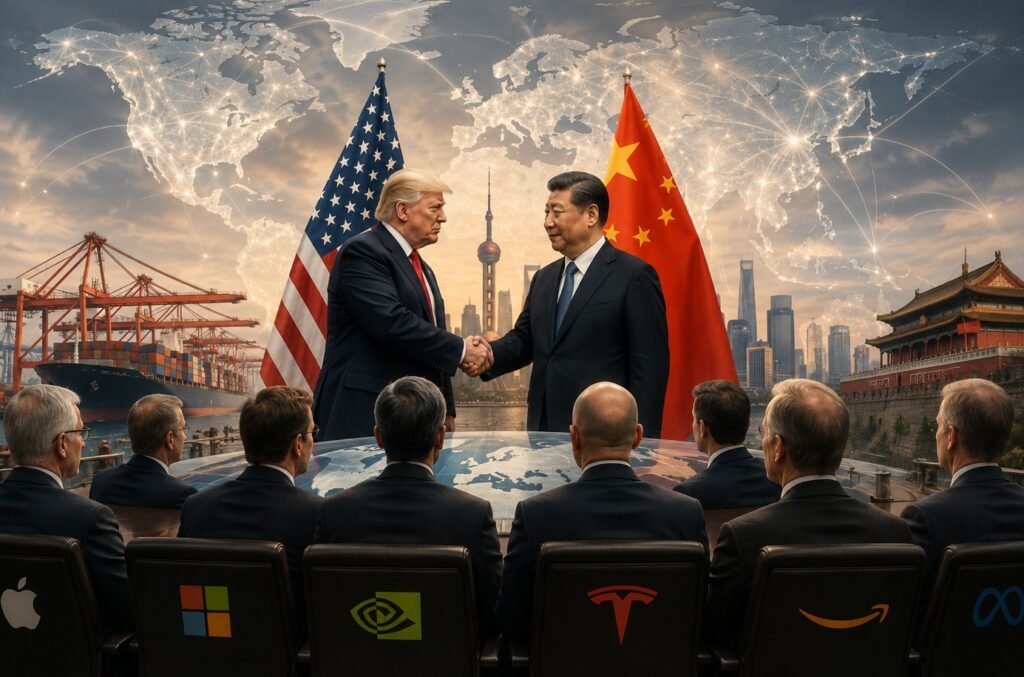

A major geopolitical and business moment is unfolding as President Donald Trump reportedly travels to China alongside some of America’s most powerful corporate leaders for high-level discussions with Chinese President Xi Jinping.
The scale of the delegation is unlike anything seen in modern US-China relations. The trip reportedly includes leaders from technology, finance, aerospace, manufacturing, semiconductors, agriculture, and investment giants signaling that this is far more than a standard diplomatic visit.
According to reports, the executives accompanying Trump include:
- Elon Musk – CEO of Tesla
- Jensen Huang – CEO of Nvidia
- Tim Cook – CEO of Apple
- Larry Fink – CEO of BlackRock
- Stephen Schwarzman – CEO of Blackstone
- Kelly Ortberg – CEO of Boeing
- Brian Sikes – CEO of Cargill
- Jane Fraser – CEO of Citigroup
- Larry Culp – CEO of GE Aerospace
- David Solomon – CEO of Goldman Sachs
- Sanjay Mehrotra – CEO of Micron Technology
- Cristiano Amon – CEO of Qualcomm
Trump has also suggested that “many other” CEOs are part of the delegation, though their names have not yet been publicly disclosed.
This isn’t just another diplomatic handshake between Washington and Beijing.
The presence of America’s most influential business leaders suggests the trip is focused heavily on economic negotiations, investment access, technology cooperation, supply chains, manufacturing, tariffs, and long-term trade agreements.
For years, the relationship between the United States and China has been defined by:
- Trade wars
- Semiconductor restrictions
- Tariffs on imports
- Technology bans
- Supply chain tensions
- Competition in artificial intelligence and advanced manufacturing
Now, this visit signals a possible shift toward negotiation and economic recalibration. When the CEOs of companies that collectively influence trillions of dollars in market value travel together with a sitting US president, global markets pay attention.
The inclusion of leaders from the semiconductor and AI industries may be the most significant aspect of the trip. Companies like Nvidia, Qualcomm, and Micron Technology sit at the center of the global AI race.
China remains one of the world’s largest technology markets, but US export restrictions have severely limited Chinese access to advanced AI chips and semiconductor technologies in recent years.
A meeting involving both political leadership and major chip executives could potentially shape AI development worldwide, future semiconductor exports, technology licensing, data infrastructure partnerships and global supply chains.
Even small policy shifts could impact the entire tech industry. Elon Musk may be one of the most closely watched figures on the trip. China is critically important to Tesla. The company’s Shanghai Gigafactory plays a central role in Tesla’s global production and sales strategy.
At the same time, Musk’s growing influence in AI, satellite communications, robotics, and aerospace gives him an unusually powerful position in discussions involving both economic and technological cooperation.
His relationship with Chinese officials has often been viewed as more pragmatic and business-oriented compared to many Western executives. The inclusion of leaders from firms like BlackRock, Goldman Sachs, Citigroup, and Blackstone highlights another important angle: capital. These firms help direct global investment flows and manage trillions of dollars in assets.
Their participation suggests discussions could involve chinese market access, investment regulations, banking partnerships, currency/capital market issues, infrastructure financing and large-scale industrial deals.
This turns the visit into more than a diplomatic event, it becomes a potential global business summit.
The presence of Boeing CEO Kelly Ortberg is especially notable. China is one of the world’s largest aviation markets, and Boeing has faced years of turbulence involving trade tensions, aircraft approvals, and competition from Airbus and China’s domestic aerospace ambitions.
Any breakthrough in aviation cooperation could carry enormous financial implications. Meanwhile, industrial and manufacturing leaders may seek agreements tied to rare earth materials, industrial production, energy cooperation, agricultural trade and infrastructure projects.
What makes this trip extraordinary is the concentration of economic power traveling together. Rarely has a US president been accompanied by such a broad coalition of CEOs from nearly every major strategic sector.
Together, these companies influence:
- Artificial intelligence
- Consumer electronics
- Aerospace
- Banking
- Energy
- Manufacturing
- Agriculture
- Global investing
- Telecommunications
The trip reflects a reality many governments now recognize: geopolitics and corporate power are increasingly interconnected. The Trump-Xi meeting comes at a time when the world economy is navigating uncertainty surrounding inflation, supply chains, AI competition, energy markets, and geopolitical tensions.
For investors and businesses, the real significance may not lie in public speeches or headlines, but in the private negotiations happening behind closed doors.
If meaningful agreements emerge from the visit, the effects could ripple across global stock markets, technology industries, international trade, semiconductor manufacturing, consumer electronics pricing, AI competition and energy and commodity markets.
It is a high-stakes gathering of political and corporate power that could influence the future direction of the global economy for years to come.